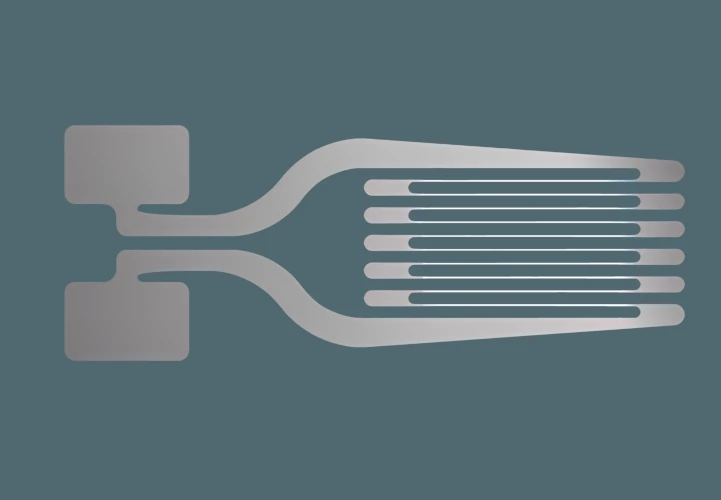
Programmet omfatter en lang række typer der dækker måling på forskellige materialer, forskellige temperaturintervaller og forskellige måleopgaver.
Alle strain gauges har som standard korte tilledninger således at pålodning af ledninger direkte på gaugen undgås (kan skade pålimningen).
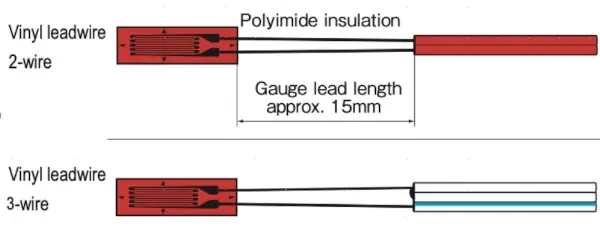
De fleste strain gauges kan leveres med fabriksmonterede ledninger. Standardtyper kan leveres med dækplade og ledninger indstøbt i denne plade, kaldet waterproof typer (WF). Standardlængder er 1, 3 eller 5m. Andre længder kan leveres efter kundespecifikation. Ledningsmonterede strain gauges leveres som standard med to eller tre ledninger. Tre ledninger muliggør kompensation for ændring i ledningernes modstand pga. ændring i temperaturen. Mest relevant for lange ledninger.
De fleste strain gauges leveres i tre konfiguration:
For hver type er angivet min og maks temperatur for typens anvendelse. Bemærk at nogle limtyper, der kan anvendes til gaugen, begrænser det tilladte temperaturinterval. Det samme gælder anvendelige ledningstyper. Temperaturkompenseringen dækker typisk ikke over hele temperaturintervallet.
De fleste gauge leveres med temperaturkompesering. Dvs. at gaugen i kompenseringsområdet ikke registrerer udvidelse eller sammentrækning pga. temperaturen. Kompenseringen tilpasses forskellige materialer med en coefficient udtrykt ved: Mx10-6/°C. M står for materialet. Forblødt stål er M 11, for rustfrit stål 17 og for aluminium 23.
Backingen er farvekodet for at vise kompenseringer. For de nævnte typer således: 11 17 23
Gauges med andre værdier for M findes.
Hvis temperaturen ikke ændres væsentligt under målingen, er kompenseringen irrelevant.
Standard strain gauges – F-typen – har en grænse for udvidelse på 5%, langt over normalt behov, andre typer noget mindre. Der er specielle typer med meget større udvidelsesgrænse, 10-40%. Udvidelsesgrænsen er angivet i oversigten.
Gauge factor. Er en central parameter for strain gauges. Dimensionsløs. Den udtrykkes således:

Er opgivet specifikt på pakningen. Ligger typisk mellem 2.0 og 2.1.
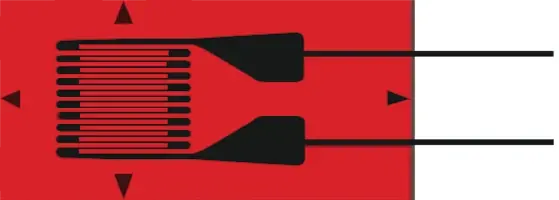
De fleste strain gauges leveres i den såkaldte Goblet® konfiguration. Denne konfiguration øger deres udmattelsesstyrke.
Her ses forskellen mellem Goblet® og standard konfigurationen:
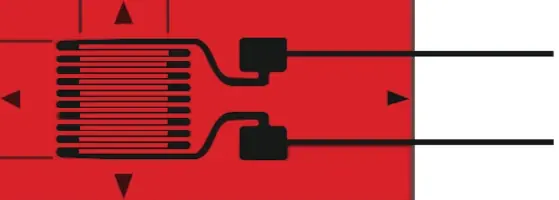
Goblet®
Standard
Alle typer vist på denne side er CE-mærkede. Der findes i TMLs program typer, der ikke opfylder kravene til CE-mærkning. De findes i TMLs hovedkatalog, men de leveres ikke i EU.
Klik her for forklaring af pakninger og de data, der opgives på dem. (32)
Klik for de enkelte typer for at se datablade. Det komplette katalog kan downloades fra ”Download” siden. Ud over produktdata, indeholder kataloget meget teknisk information.
F-serien
F series gauges are for general use and the most commonly used strain gauges in TML’s product line. These gauges employ Cu-Ni alloy foils for the grid and epoxy resin for the backing. The special plastic backing exhibits excellent electrical insulation performance, and is color-coded to identify the objective material for self-temperature-compensation.
| Applicable specimen | Metal, Ceramics, Composite |
|---|---|
| Gauge resistance | 120, 350 Ohm |
| Gauge length (mm) | 0.2 - 0.3 - 0.5 -1 – 2 – 3 – 5 – 6 – 10 – 30 |
| Gauge elements | Single, double, triple |
| Operational temperature | -196 to +150 °C |
| Temperature compensation range | +10 to +100 °C |
| Compensation available (M) | 11 17 23 |
| Applicable adhesive | CN, P-2, EB-2 |
| Strain limit | 5 % |
| Fatigue, No. of cycles, Strain level | 1 x 10⁶ (±1500 x 10-6 strain) |
| Extension leadwires | Available |
WF-Serien
These gauges eliminate the need for a moisture-proofing coating, which is sometimes troublesome in a field test. These have an integral vinyl leadwire, and whole area of the strain gauge and the leadwire junction are coated with epoxy resin. The coating is transparent and flexible, so the positioning and bonding works are very easy. By merely bonding the gauge with CN or P-2 adhesive, outdoor or underwater measurement for a short-term becomespossible. These gauges are also effective in eliminating the primary coating in case of applying a multi-layer coating.
| Applicable specimen | Metal, Ceramics, Composite |
|---|---|
| Gauge resistance | 120, 350 Ohm |
| Gauge length (mm) | 3 - 6 |
| Gauge elements | Single, double, trible |
| Operational temperature | 0 to +80 °C |
| Temperature compensation range | +10 to +80 °C |
| Compensation available (M) | 11 17 23 |
| Applicable adhesive | CN, P-2, EB-2 |
| Strain limit | 3 % |
| Fatigue, No. of cycles, Strain level | 3 x 10⁴ (±1500 x 10-6 strain) |
| Extension leadwires | Integrated |
QF- serien
Strain gauges for high temperature use. Goes beyond QF gauges. These are foil strain gauges utilizing polyimide resin as the backing material.
| Applicable specimen | Metal, Ceramics, composite |
|---|---|
| Gauge resistance | 120, 350, 1000 Ohm |
| Gauge length (mm) | 0.2 - 0.3 -1 – 2 – 3 – 5 – 6 – 30 |
| Gauge elements | Single, double, triple |
| Operational temperature | -30 to +200 °C |
| Temperature compensation range | +10 to +100℃ |
| Compensation available (M) | 11 17 23 28 (Same for all) |
| Applicable adhesive | CN, NP-50B, C-1, EB-2 |
| Strain limit | 3 % |
| Fatigue, No. of cycles, Strain level | 3 x 10⁴ (±1500 x 10-6 strain) |
| Extension leadwires | Available |
ZF-serien
Strain gauges for high temperature use. Goes beyond QF gauges. These are foil strain gauges utilizing polyimide resin as the backing material.
| Applicable specimen | Metal, Ceramics, composite |
|---|---|
| Gauge resistance | 60, 120, 350 Ohm |
| Gauge length (mm) | 1 – 2 – 3 – 6 |
| Gauge elements | Single, double, triple |
| Operational temperature | -30 to +300℃ |
| Temperature compensation range | +10 to +100℃ |
| Compensation available (M) | 11 17 23 (Same for all) |
| Applicable adhesive | CN, NP-50B, C-1, EB-2 |
| Strain limit | 1% |
| Fatigue, No. of cycles, Strain level | 1 x 10⁶ (±1500 x 10-6 strain) |
| Extension leadwires | Available |
EF- serien
These gauges have a small grid pattern required for measurement of printed circuit boards and surface mounted devices, which are getting smaller and smaller. The backing of the gauges is made of polyimide resin. The maximum operaing temperature is +300°C for single element gauges and +200°C for two and three elements gauges. The lowest operating temperature is ‒196°C for both gauges.
| Applicable specimen | Metal, Ceramics, Composite |
|---|---|
| Gauge resistance | 120 Ohm |
| Gauge length (mm) | 0.2 – 0.5 |
| Gauge elements | Single, double, triple |
| Operational temperature | -196 to +200 or +300 °C |
| Temperature compensation range | 0 or +10 to +150 °C |
| Compensation available (M) | 11 |
| Applicable adhesive | CN, NP-50B, C-1, EB-2 |
| Strain limit | 1% |
| Fatigue, No. of cycles, Strain level | 1 x 10⁶ (±1500 x 10-6 strain) |
| Extension leadwires | Available |
HZF- serien
These adhesive bonded high-temperature strain gages are capable of measuring temperatures up to 350°C. The gage leads are welded to the high-temperature lead wires.
| Applicable specimen | Metal |
|---|---|
| Gauge resistance | 120 Ohm |
| Gauge length (mm) | 2 |
| Gauge elements | Single |
| Operational temperature | -30 to +300 °C ( 350 °C short cycle) |
| Temperature compensation range | +10 to +300 ℃ |
| Compensation available (M) | 11 17 23 (Same for all) |
| Applicable adhesive | NP-50B, C-1 |
| Strain limit | 1% |
| Fatigue, No. of cycles, Strain level | 1 x 10⁶ (±1500 x 10-6 strain) |
| Extension leadwires | Integrated |
These are strain gauges utilizing polyimide resin for the gauge backing and special alloy foil for the grid. It features a wide range of operating temperature from cryogenic temperature to +200°C. This series is available only in single axis configuration with gauge length of 1, 3 and 6mm.
| Applicable specimen | Metal, Ceramics, Composite |
|---|---|
| Gauge resistance | 350 Ohm |
| Gauge length (mm) | 1 – 3 – 6 |
| Gauge elements | Single |
| Operational temperature | -269 to +200 °C |
| Temperature compensation range | -196 to +80 °C |
| Compensation available (M) | 11 17 23 (Same for all) |
| Applicable adhesive | C-1, EA-2A, CN |
| Strain limit | 1% |
| Fatigue, No. of cycles, Strain level | 1 x 10⁶ (±1500 x 10-6 strain) |
| Extension leadwires | Available |
CF- serien
These are foil strain gauges with epoxy backing designed for measurement under cryogenic conditions. They are available in single element, rectangular 2-element and rectangular 3-element configurations with 350Ω resistance. The specially selected and heat treated grid of the gauges shows very small zero shift under cryogenic temperature compared to conventional strain gauges.
| Applicable specimen | Metal, Ceramics, Composite |
|---|---|
| Gauge resistance | 350 Ohm |
| Gauge length (mm) | 1 – 3 – 6 |
| Gauge elements | Single, double, triple |
| Operational temperature | -269 to +80 °C |
| Temperature compensation range | -196 to +80 °C |
| Compensation available (M) | 11 17 23 |
| Applicable adhesive | EA-2A, C-1, CN |
| Strain limit | 1% |
| Fatigue, No. of cycles, Strain level | 1 x 10⁶ (±1500 x 10-6 strain) |
| Extension leadwires | Available |
P-serien
These are wire strain gauges with a grid made of fine electric resistance wire formed on a polyester resin backing. They are used for measurement of surface strain on concrete, mortar or rocks, and also for short-term measurement on wood.
| Applicable specimen | Concrete, mortar, rocks (wood) |
|---|---|
| Gauge resistance | 120 Ohm |
| Gauge length (mm) | 60 – 90 – 120 |
| Gauge elements | Single, double, trible |
| Operational temperature | -20 to +80 ℃ |
| Temperature compensation range | +10 to +80 ℃ |
| Compensation available (M) | 11 (Backing clear) |
| Applicable adhesive | CN-E, RP-2, PS |
| Strain limit | 2 % |
| Fatigue, No. of cycles, Strain level | 1 x 10⁵ (±1500 x 10-6 strain) |
| Extension leadwires | Available |
PF-serien
These are foil strain gauges utilizing a polyester resin backing which is the same as the P series. The gauge length is available in 3 ranges of 10, 20 and 30mm, so it is suited mainly to strain measurement on concrete or mortar.
| Applicable specimen | Concrete, mortar, rocks |
|---|---|
| Gauge resistance | 120 Ohm |
| Gauge length (mm) | 10 – 20 – 30 |
| Gauge elements | Single, double, treble |
| Operational temperature | -20 to +80 ℃ |
| Temperature compensation range | +10 to +80 ℃ |
| Compensation available (M) | 11 (Backing clear) |
| Applicable adhesive | CN-E, RP-2, PS |
| Strain limit | 2 % |
| Fatigue, No. of cycles, Strain level | 1 x 10⁵ (±1500 x 10-6 strain) |
| Extension leadwires | Available |
F-series (glass-ceramics)
These are foil strain gauges i the F family, but with temperature compensation The gauge length is available in 3 ranges of 10, 20 and 30mm, so it is suited mainly to strain measurement on concrete or mortar.
| Applicable specimen | Glass, ceramics |
Gauge resistance | 120 Ohm |
| Gauge length (mm) | 2 – 5 |
| Gauge elements | Single, double, triple |
| Operational temperature | -60 to +150 °C |
| Temperature compensation range | +10 to +100 °C |
| Compensation available (M) | 8 |
| Applicable adhesive | CN, P-2, EB-2 |
| Strain limit | 5 % |
| Fatigue, No. of cycles, Strain level | 1 x 10⁶ (±1500 x 10-6 strain) |
| Extension leadwires | Available |
UBF- serien
These are foil strain gauges developed for measurement on composite materials. They have a specially designed grid pattern to reduce the stiffening effect of the strain gauges. In addition, owing to the development of gauge backing with better compliance, the number of repetition in thermal cycling test and the creep characteristics have been significantly improved compared to conventional strain gauges.
| Applicable specimen | Composite |
|---|---|
| Gauge resistance | 120 Ohm |
| Gauge length (mm) | 0.3 – 1 |
| Gauge elements | Single |
| Operational temperature | -30 to +150 °C |
| Temperature compensation range | N/A |
| Applicable adhesive | CN, EB-2 |
| Strain limit | 3% |
| Fatigue, No. of cycles, Strain level | 1 x 10⁶ (±1500 x 10-6 strain) |
| Extension leadwires | Available |
BF-serien
These are strain gauges designed for measurement on composite materials. They have a specially designed grid pattern to reduce the stiffening effect of the strain gauge to the measurement object. Coefficient of linear thermal expansion for temperature compensation is available in 3, 5, and 8×10⁻⁶/°C, which are applicable to ceramic, carbon or composite materials.
| Applicable specimen | Composite, ceramic |
|---|---|
| Gauge resistance | 120 Ohm |
| Gauge length (mm) | 2 – 5 |
| Gauge elements | Single, double, treble |
| Operational temperature | -30 to +200 °C |
| Temperature compensation range | 3 5 8 (Same for all) |
| Applicable adhesive | CN-E, NP-50B, EB-2 |
| Strain limit | 3% |
| Fatigue, No. of cycles, Strain level | 1 x 10⁶ (±1500 x 10-6 strain) |
| Extension leadwires | Available |
GF- serien
These strain gauges are suited to the measurement on materials such as plastics, which have low elastic modulus compared to metal. Our original specially-designed grid lowers the rigidity of the strain gauge and reduces the stiffening effect to the specimen material.
| Applicable specimen | Plastic, composite |
|---|---|
| Gauge resistance | 120, 350 Ohm |
| Gauge length (mm) | 3 – 6 |
| Gauge elements | Single, double, treble |
| Operational temperature | -30 to +80 °C |
| Temperature compensation range | +10 to +80 °C |
| Compensation available (M) | 50 70 |
| Applicable adhesive | CN |
| Strain limit | 3% |
| Fatigue, No. of cycles, Strain level | 1 x 10⁶ (±1500 x 10-6 strain) |
| Extension leadwires | Available |
LF- serien
This is a foil strain gauge utilizing special plastics for the backing. It has a grid designed for materials with low elastic modulus, and the stiffening effect on the measurement object is reduced.
| Applicable specimen | Plastic, composite | ||
|---|---|---|---|
| Gauge resistance | 120 Ohm | ||
| Gauge length (mm) | 10 | ||
| Gauge elements | Single | ||
| Operational temperature |
| ||
| Temperature compensation range | +10 to +80 ℃ | ||
| Compensation available (M) | 11 | ||
| Applicable adhesive | CN | ||
| Strain limit | 3% | ||
| Fatigue, No. of cycles, Strain level | 1 x 10⁶ (±1500 x 10-6 strain) | ||
| Extension leadwires | Available |
PFLW/PLW-serien
These gauges are specially designed for long term measurement on wood. They have a metal foil lined on the back of the PFL or PL strain gauges. The metal foilis effective to protect the strain gauges from an influence of moisture in the wood. These gauges should be bonded with PS adhesive to make the best of their performance.
| Applicable specimen | Wood |
|---|---|
| Gauge resistance | 120 Ohm |
| Gauge length (mm) | 30 - 60 |
| Gauge elements | Single |
| Operational temperature | -20 to +80 ℃ |
| Temperature compensation range | +10 to +80 ℃ |
| Compensation available (M) | 11 (backing clear) |
| Applicable adhesive | PS |
| Strain limit | 2% (20000 x 10-6 strain) |
| Fatigue, No. of cycles, Strain level | 1 x 10⁶ (±1500 x 10-6 strain) |
| Extension leadwires | Available |
QMF-serien
These are non-inductive strain gauges suited to the measurement in magnetic field. The sensing element of this gauge consists of two identical grids with one grid folded back on another. This construction makes to cancel the electromagnetically induced noise each other. The twisted leadwire is also effective to cancel the induced noise in the same way. Accordingly, this strain gauge is less sensitive to the influence of noise induced in changing magnetic field.
| Applicable specimen | Metal |
|---|---|
| Gauge resistance | 120, 350 Ohm |
| Gauge length (mm) | 2 - 5 |
| Gauge elements | Single, double, treble |
| Operational temperature | -30~+200℃ |
| Temperature compensation range | 0~+150℃ |
| Compensation available (M) | 11 17 23 (same for all) |
| Applicable adhesive | CN, NP-50, EB-2 |
| Element | Ni-Cr |
| Strain limit | 1% |
| Fatigue, No. of cycles, Strain level | 1 x 10⁵ (±1500 x 10-6 strain) |
| Extension leadwires | Available |
YEF-serien
These gauges are applicable to the measurement of large strain up to 10~15%. Also these withstand the repeated strain in elastic range (at strain level ±1500×10-6 strain) like ordinary strain gauges. However, these are not applicable to the measurement of repeated strain in a large range.
| Applicable specimen | Plastic, composite, metal | ||
|---|---|---|---|
| Gauge resistance | 120 Ohm | ||
| Gauge length (mm) | 2 - 5 | ||
| Gauge elements | Single, double, treble | ||
| Operational temperature |
| ||
| Temperature compensation range | N/A | ||
| Applicable adhesive | CN, CN-Y | ||
| Strain limit | 10 to 15 % | ||
| Fatigue, No. of cycles, Strain level | 5 x 10⁵ (±1500 x 10-6 strain) | ||
| Extension leadwires | Available |
YF-serien
These gauges are applicable to the measurement of large strain up to 15 to 20%. These are not applicable to the measurement of repeated strain in elastic range as well as in large range.
| Applicable specimen | Plastic, composite, metal |
|---|---|
| Gauge resistance | 120 Ohm |
| Gauge length (mm) | 2 – 5 – 10 - 20 |
| Gauge elements | Single |
| Operational temperature | -20 to +80 ℃ |
| Temperature compensation range | N/A |
| Applicable adhesive | CN, CN-Y |
| Strain limit | 15 to 20 % |
| Fatigue, No. of cycles, Strain level | - |
| Extension leadwires | Available |
YHF-serien
These gauges are developed for the measurement of very large strain up to 30~40%. These are not applicable to the measurement of repeated strain in elastic range as well as in large range.
| Applicable specimen | Plastic, composite, metal | ||
|---|---|---|---|
| Gauge resistance | 120 Ohm | ||
| Gauge length (mm) | 2 – 5 | ||
| Gauge elements | Single | ||
| Operational temperature |
| ||
| Temperature compensation range | N/A | ||
| Applicable adhesive | CN, CN-Y | ||
| Strain limit | 30 to 40 % | ||
| Fatigue, No. of cycles, Strain level | 2 x 10⁴ (±1500 x 10-6 strain) | ||
| Extension leadwires | Available |
F-serien
In the F series, strain gauges dedicated to a special usage (shearing strain measurement, torque measurement, residual stress measurement or stress concentration measurement) can be found.
| Applicable specimen | Metal, Ceramics, Composite |
|---|---|
| Gauge resistance | 120, 350 Ohm |
| Gauge length (mm) | See details |
| Gauge elements | See details |
| Operational temperature | -196 to +150 ℃ |
| Temperature compensation range | +10 to +100 ℃ |
| Compensation available (M) | 11 17 23 |
| Applicable adhesive | CN, P-2, EB-2 |
| Strain limit | 5 % |
| Fatigue, No. of cycles, Strain level | 1 x 10⁶ (±1500 x 10-6 strain) |
| Extension leadwires | Available |
QF-serien
In the F series, strain gauges dedicated to a special usage (shearing strain measurement, torque measurement or stress concentration measurement).
| Applicable specimen | Metal, Ceramics, Composite |
|---|---|
| Gauge resistance | 120, 350 Ohm |
| Gauge length (mm) | See details |
| Gauge elements | See details |
| Operational temperature | -20 to +200 °C |
| Temperature compensation range | +10 to +100 ℃ |
| Compensation available (M) | 11 17 23 |
| Applicable adhesive | CN, NP-50B, C-1, EB-2 |
| Strain limit | 3% |
| Fatigue, No. of cycles, Strain level | 1 x 10⁶ (±1500 x 10-6 strain) |
| Extension leadwires | Available |
SF-serien
These gauges are intended to measure the stress in an optional direction of the specimen in plane stress field. The gauges are sensitive not only in these axial direction but also in the transverse direction, and the sensitivity ratio of the transverse direction to the axial direction is equal to the Poisson’s ratio of the specimen material. In addition, the gauges are not sensitive to the shearing strain. Accordingly, the output of the gauges is proportional to the stress in the axial direction. The gauges are available in three types depending on the Poisson’s ratio of the specimen material.
| Applicable specimen | Metal, Ceramics, Composite |
|---|---|
| Gauge resistance | 120 Ohm |
| Gauge length (mm) | 4 |
| Gauge elements | Single (see details) |
| Operational temperature | -20 to +200℃ |
| Temperature compensation range | +10 to +100℃ |
| Compensation available (M) | 11 17 23 (same for all) |
| Applicable adhesive | CN, NP-50B, C-1 |
| Strain limit | - |
| Fatigue, No. of cycles, Strain level | 1 x 10⁶ (±1500 x 10-6 strain) |
| Extension leadwires | Available |
CTE-serien
The CTE series of strain gauges for measuring the coefficient of linear expansion is a product in which the temperature-compensated material of the strain gauge is adjusted to 0×10-6/°C so that the coefficient of linear expansion of any material can be easily calculated. They can also measure total elongation (strain due to external force +thermal strain), making them effective for measuring strain on electronic circuit boards.
| Applicable specimen | Plastic, composite |
| Gauge resistance | 120, 350 Ohm |
| Gauge length (mm) | 3 - 6 |
| Gauge elements | Single |
| Operational temperature | -30 to +200 °C |
| Temperature compensation range | +10 to +100 °C |
| Compensation available (M) | - |
| Applicable adhesive | CN, NP-50, C-1, EB-2 |
| Strain limit | 1 % |
| Fatigue, No. of cycles, Strain level | 1 x 10⁵ (±1500 x 10-6 strain) |
| Extension leadwires | Available |
DSF-serien
These gauges are designed for fatigue tests, and can reach a fatigue life of over 10 million times at strain level ±3000×10-6 strain. Compared to previously (1 million times at ±1500×10-6 strain), these are gauges of exceptionally high durability.
In aviation and other areas, repeated load tests of large elongation of composite materials are conducted. However, it had been necessary to adhere a new strain gauge frequently as a gauge reached its fatigue life.
The DSF series greatly reduces time and cost of adhering gauges.
Applicable specimen | Metal, plastic, composite |
Gauge resistance | 350 Ohm |
Gauge length (mm) | 2 - 5 |
Gauge elements | Single |
| Operational temperature | -60 to +200 °C |
| Temperature compensation range | N/A |
| Applicable adhesive | CN, C-1, EB-2 |
| Strain limit | 1 % |
| Fatigue, No. of cycles, Strain level | 1 x 10⁷ (±3000 x 10-6 strain) |
| Extension leadwires | Available |
AW-serien(AWM・AWMD・AWH・AWHU・AW・AWC)
These strain gauges have strain sensing elements fully encapsulated in corrosion-resisting metal tubes made of stainless steel or Inconel (except AW-6-350). The strain gauge backings are also made of the same material, and the gauges are installed by spot welding to metal specimens using a dedicated spot welder. The operational temperature depending on type goes from +300 °C to +800 °C.
BTM/BTMC-serien
These gauges are used for measurement of tensile strain of bolt. They are simply inserted into pre-drilled hole in the bolt with exclusive adhesives. This method is recommendable when an ordinary strain gauges can not be mounted on the bolt surface. Accurate tensile force measurement is possible by calibrating the bolt after installing the bolt gauges. The BTM bolt gauges use heat-curing A-2 adhesive for installation, which provides better long-term stability.
FAC-serien
These gauges are designed to measure the propagation speed of fatigue crack in a metal specimen. The gauges are bonded with an adhesive on the position where the crack is initiated or the crack initiation is expected. The grids of the gauges, which are aligned at interval of 0.1mm or 0.5mm, are disconnected one by one with the propagation of the crack. The gauges are used together with the crack gauge adapter CGA-120B, and the disconnection of one grid is measured as the change of approx. 45 or 40×10-6 strain by a strainmeter.
TF-serien
These gauges are bonded on the specimen surface like ordinary strain gauges, and measure the surface temperature. By combining with the dedicated temperature gauge adapter (TGA-1A or TGA-1B), actual temperature can be measured easily using a strainmeter.
These strain transducers are designed for measurement of strain in materials such as concrete, mortar or synthetic resin. Measurement is possible not only after the material is cured but also during the stage of curing. The elastic modulus of the transducers is equivalent to approximately 40N/mm2. Therefore, measurement is possible right after the concrete is placed. The waterproof construction of the transducers makes the transducers totally impervious to moisture absorption and offers excellent stability for long-term strain measurement. The thermocouple-integrated transducers enable real temperature measurement simultaneously with strain measurement, greatly saving the wiring works. In addition to the internal strain measurement, surface strain measurement on concrete or steel such as H-beam steel is also available using various optional accessories.
TML strain gauges are used not only for the purpose of knowing strain/stress but also as sensors for strain gauge type transducers. A strain gauge type transducer converts physical quantity such as load, pressure or displacement into mechanical strain on the strain generating body (elastic body), and the mechanical strain is converted into electrical output using strain gauges mounted on the elastic body. We offer various types of transducer-specific strain gauges featuring highly reliable and stable performance.
• Force transducers (Load Cells)
• Pressure transducers
• Acceleration transducers
• Displacement transducers
• Torque transducers
Lim
TML offer various adhesives, all tested for mounting of strain gauges. For each strain gauge type, applicable adhesives are listed.
Coating
TML offer various coatings, all tested for strain gauges.
The basic requirements to coatings are:
1) They must be non-corrosive, i.e. also for mild steel.
2) The stiffness must be much lower than the tested material so the total stiffness of the tested area is not affected.
3) It must match the test temperatures.
4) Good adhesive to the material tested.
Standard silicone rubber products as well as standard epoxy adhesives might be found for the purpose. Such are often used for coating.
Ledningstyper
Virtually all types can be supplied with factory-fitted wires.
Supplied with two or three wires per gauge. Three wires enable compensation for change in wire resistance due to temperature change. Most relevant for long wires.
Wire mounted strain gauges are supplied with two or three wires as standard. Three wires enable compensation for changes in the resistance of the wires due to changes in temperature. Most relevant for long cables.
Standard lengths are 1, 3 and 5m, but other lengths can be supplied on customer request.
Standard is vinyl leadwires. There is a non-isolated part between the gauge and the isolated wire as shown.
For single gauges is the standard wire LJC-F (2 wire) and LJCT-F (3 wire)
For double or trible gauges is the standard wire LJB-F (2 wire) and LJBT-F /3 wire)
The temperature allowed for these is -20 to +80 0C
For higher temperature is LXT-F (3 wire) the most common used. The temperature allowed for this is -20 to +150 0C
Other leadwires can be delivered on request.
For a complete overview of available leadwires combined with strain gauge types, click here:
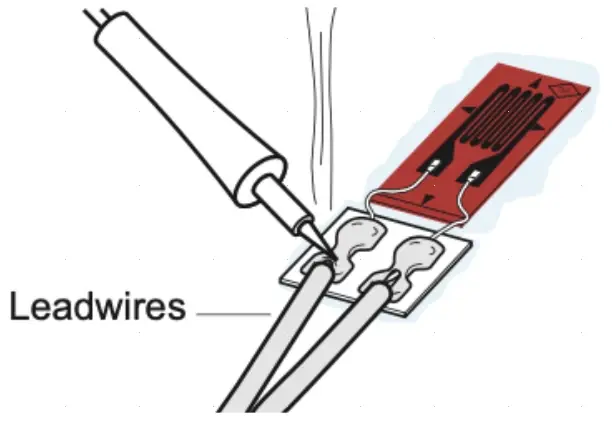
Terminals are used for connecting the short wires from the gauge to longer isolated lead wires. They are mounted with the same adhesive as the gauge. The wires are soldered to the terminal. This might take place before gluing.
| Wea Technology A/S | CVR nr. 20276045 |
| Amagergade 15 | Kontakt: |
| 1423 København K | Email: wea@wea.dk |
| Danmark | Telefon: +45 46383202 |